September 2, 2026
Suno scored 28. That number needs a footnote.
1 September 2026
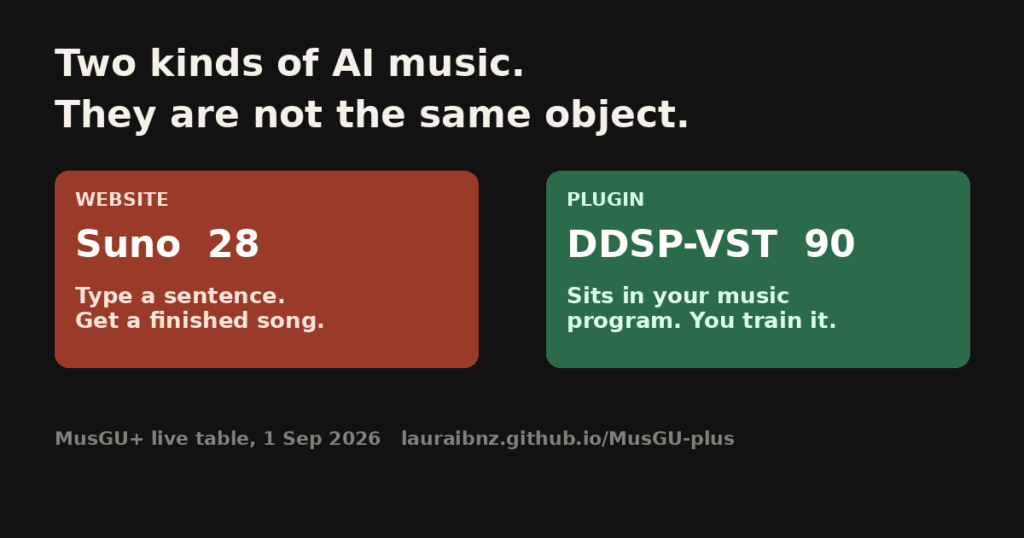
Suno scored 28 out of 100. A public scorecard of AI music tools put it near the bottom, while a Google plugin sits near the top. If you have used paid Suno, that ranking can look wrong. You can upload a vocal. You can point the system at your own projects. It does learn something from you. This piece explains who wrote the scores, what the words mean, and where the table and the product disagree.
Who made the score
MusGU+ is not a magazine poll and not Suno’s marketing. It is an academic evaluation grid plus a website, aimed at AIMC 2026, the AI Music Creativity conference in Berlin, 16–18 September.[1][2][4]
The paper on GitHub still says “anonymous authors” because it is under review.[2] The repository is not anonymous. The main commits come from Laura Ibáñez-Martínez, a PhD student at the Music Technology Group, Universitat Pompeu Fabra, in Barcelona.[2][9] Roser Batlle-Roca, also at UPF, built the earlier MusGO grid (openness of music models) and contributed here.[2][10] Błażej Kotowski shows up in the commit log; he also works on PLAUD, one of the tools in the table.[2][11]
So: university researchers in music technology, not a start-up leaderboard. They published the criteria, a YAML file per tool, and a filterable table. Anyone can open an issue and argue a score.[2]
That last point matters. If Suno’s paid features should move the adaptability number, the honest place to fight is that YAML, not a vibe.
What they are scoring
MusGU+ stands for Music-Generative Usable+ AI. Three questions, each broken into smaller checks that can only be yes, partly, or no.[3]
Adaptability. Can I realistically adapt this model to my own data? Their examples are training code, checkpoints, LoRA, a Colab that fine-tunes weights, a plugin you train on a short recording and then keep. They also ask whether you can take that adapted model with you (redistribution).[3][7]
Usability. Can I run it, pay for it, put it in a DAW, export stems, get help when it breaks.[3]
Controllability. Can I steer the music on purpose: MIDI, lyrics, audio input, pitch, time, not only a text prompt.[3]
Overall is the average of those three. Fourteen tools on 1 September 2026. Mean 59.5.[1]
Two products, same marketing word
People say “AI music” for both of these.
Suno (and Udio) is a website and an app. You type a description or lyrics. Their computers in the cloud write a finished song. On Pro and Premier you also get Suno Studio, upload audio (up to 30 minutes), Voices, add vocals, and a line on the pricing page called Custom Models.[8] You do not install a music engine on your PC. You rent access.
A VST (AU on a Mac) is a small program that plugs into the mixing software already on your machine: Ableton, Logic, Reaper, Cubase. Think of a guitar pedal, except digital. DDSP-VST, from Google Magenta, is that kind of object. Magenta’s notes, quoted in MusGU+, say you can train a usable instrument on about 10 to 20 minutes of monophonic audio, then play it in real time inside the DAW.[1][3]
If you only know Suno, “plugin scored 90” sounds like snobbery. If you only know VSTs, “Suno scored 28” sounds like the researchers never opened the paid plan. Both reactions are fair until you read what “adapt” means in their spreadsheet.
The table
Live numbers, 1 September 2026.[1]
| What you are looking at | Name | Overall | Adapt. | Use | Control |
|---|---|---|---|---|---|
| Plugin in a DAW | DDSP-VST (Google Magenta) | 90 | 70 | 100 | 100 |
| Musician-facing app / plugin | Neutone Morpho | 82 | 80 | 92 | 75 |
| Research software you can run | RAVE (IRCAM) | 79 | 70 | 92 | 75 |
| Research software | AFTER (IRCAM) | 78 | 50 | 83 | 100 |
| Research tool, Barcelona | SCAPES (UPF) | 77 | 90 | 67 | 75 |
| Research tool, Barcelona | PLAUD (UPF) | 76 | 70 | 83 | 75 |
| Easy to start, hard to retrain | Magenta RealTime 2 | 65 | 20 | 100 | 75 |
| Company audio model | Stable Audio 3 | 58 | 60 | 75 | 38 |
| University song model | YuE | 49 | 40 | 58 | 50 |
| Lab model | JAM | 44 | 40 | 42 | 50 |
| Downloadable Meta model | MusicGen | 43 | 30 | 50 | 50 |
| Smaller Stability model | Stable Audio Open Small | 43 | 40 | 50 | 38 |
| Website / app | Suno | 28 | 0 | 58 | 25 |
| Website / app | Udio | 21 | 0 | 50 | 12 |
The Suno problem
Suno’s adaptability is 0 in MusGU+. The researchers wrote, in the Suno file, that no training or fine-tuning path is exposed: no code, no checkpoints, no interface that produces a model you can keep. Weights stay on Suno’s servers. Redistribution is not allowed under the terms.[6][7]
That is a specific claim. It is not “Suno never hears the user.”
On the pricing page, Pro and Premier list Upload Audio (30 minutes), Voices, Add vocals, Custom Models, and Suno Studio.[8] The same MusGU+ file already admits audio-guided generation, lyrics, tags, continuation, editing, and remixing. They filed that under controllability, not adaptability, and still only gave it a partial.[7]
So if you pay, upload a vocal, and hear the next song come back in something like your voice, you are not imagining it. The product is built to condition on your audio. A musician would call that learning from the user. MusGU+ would call it a prompt with a sound file attached. They reserve “adapt” for: I change the model, I can run the result without their website, I could share the adapted weights.
Those are different jobs. The 0 is honest inside their definition and misleading if you read “adapt” as “the app gets to know my projects.” The article should have said that in the first version. It did not.
If the paid Custom Models path is real fine-tuning of a private model (still hosted), MusGU+ might still score redistribution as no, and hardware/dataset as “cannot say,” but “no adaptation pathways” would be too blunt. That is a fair challenge to send to their GitHub issues.[2][8]
What still stands
The table is useful once you know the rule. Tools you can train on a short personal recording and then play inside a DAW sit at the top. Tools that only exist as a cloud jukebox sit at the bottom, even if the jukebox is good, even if it accepts your vocal.
Usability is the column where Suno is not a joke: 58, with a full mark for the web and phone apps.[6] People use it because it is easy. The researchers did not deny that. They asked a different question.
MusGO, Batlle-Roca’s earlier project, scores how open the science is. MusGU+ scores whether a musician can adopt the thing on their own terms.[2][5] AIMC 2026 will spend three days in Berlin on “spawned” music and who owns the interface.[4] This spreadsheet is the unglamorous version of that argument.
Live table: https://lauraibnz.github.io/MusGU-plus/
Suno’s own score sheet: https://lauraibnz.github.io/MusGU-plus/models/suno/
Sources
- https://lauraibnz.github.io/MusGU-plus/ (table scraped 1 Sep 2026)
- https://github.com/lauraibnz/MusGU-plus
- https://lauraibnz.github.io/MusGU-plus/framework.html
- https://aimc2026.org/home
- https://roserbatlleroca.github.io/MusGO_framework/
- https://lauraibnz.github.io/MusGU-plus/models/suno/
- https://raw.githubusercontent.com/lauraibnz/MusGU-plus/main/projects/suno.yaml
- https://suno.com/pricing
- https://github.com/lauraibnz
- https://github.com/roserbatlleroca
- https://github.com/blazejkotowski